A440, A442 or A415: which pitch should a piano be tuned to?
What concert pitch means, who uses which, and what changing it does to a piano.
A440 is the standard: the A above middle C vibrates at 440 Hz. It was agreed at an international conference in London in 1939 and is written into ISO 16, the international standard for tuning frequency. Most pianos, electronic keyboards, recordings and tuners assume it. Some orchestras tune a little higher, often to 442 or 443 Hz, and early-music groups playing on period instruments commonly use A415.
The common reference pitches
| A4 | Cents from A440 | Who uses it |
|---|---|---|
| 466 Hz | +100 | Some early-music repertoire, a semitone above 440 |
| 443 Hz | +11.8 | Some orchestras, mostly in continental Europe |
| 442 Hz | +7.9 | Many orchestras and the pianos they play with |
| 440 Hz | 0 | The ISO 16 standard; nearly everything else |
| 432 Hz | −31.8 | A personal preference some people request |
| 430 Hz | −39.8 | Sometimes used for classical-era period instruments |
| 415 Hz | −100 | Baroque period instruments, a semitone below 440 |
| 392 Hz | −200 | Some French baroque music, a whole tone below 440 |
The cents column uses the usual formula: cents = 1200 × log2(new A ÷ 440). One hundred cents is one equal-tempered semitone. That is why 415 and 466 turn up as baroque pitches: 415.3 Hz and 466.16 Hz are exactly a semitone below and above 440, so a player can transpose by one key instead of retuning.
What changing the pitch does to a piano
Every string on the piano has to move. String tension rises with the square of the frequency, so:
- 440 to 442 is about 7.9 cents up and roughly 0.9 percent more tension on every string. A routine change for a piano that already lives at 442.
- 440 to 415 is a full semitone down and roughly 11 percent less tension. The soundboard and plate carry a very different load, and the tuning will drift for a while afterwards.
- Switching back and forth between pitches is harder on stability than either pitch alone, which is why halls that host both modern and period ensembles often keep a separate instrument, or schedule the change with time to settle.
A small move like 440 to 442 fits into a normal tuning. A large one behaves more like a pitch raise and may need two passes.
A piano that reads flat is not “at a different pitch”
People sometimes find their piano reads 10 or 30 cents low and assume it was tuned to a lower standard. Almost always it has simply drifted, usually flat, through seasons and time without a tuning. The fix is a tuning back to 440 (or whatever pitch it should be at), not a new reference. See why pianos go out of tune for the reasons.
Which pitch should you choose?
- Home or school piano: 440. It matches backing tracks, apps, keyboards and other players.
- A piano that accompanies one orchestra or choir: whatever that group tunes to. Ask the conductor or concertmaster; 442 is common.
- Playing with recordings tuned elsewhere: change the reference in your software, not the piano, if you can.
- Early music on a modern piano: usually not worth a semitone change. Period-pitch ensembles bring instruments built for it.
Check the pitch yourself
- Open the online piano tuner and set the A4 reference to 440 Hz (it goes from 392 to 466 Hz).
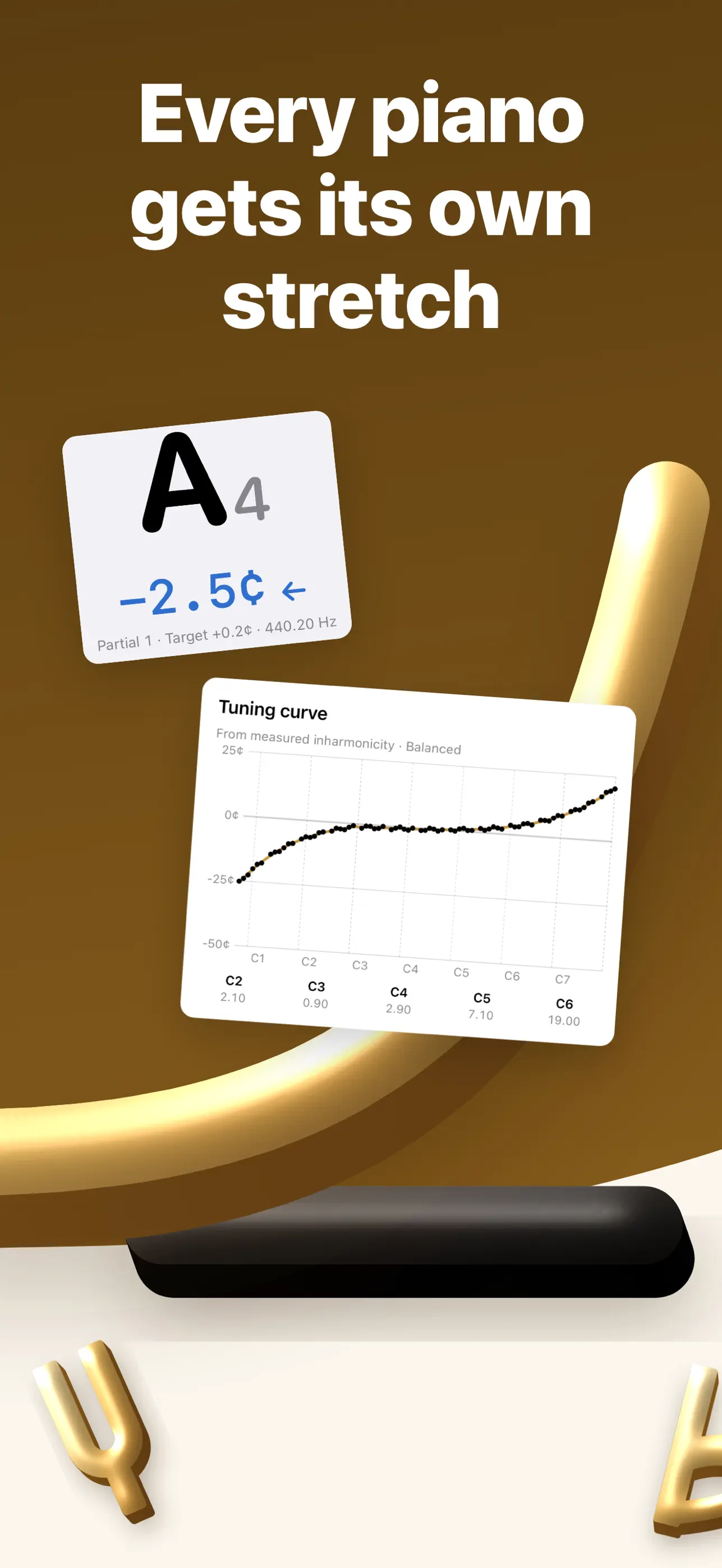
- Play A4 and hold it. The reading shows the note, the cents from target and the frequency.
- Play a few other A’s up and down the keyboard to see whether the whole piano moved together or only parts of it.
The piano key frequencies table lists the equal-tempered target for all 88 keys at any A4, so you can see what 442 means for every note. Remember that a well-tuned piano is stretched: its low bass reads a few cents flat and its high treble a few cents sharp of those numbers, on purpose.
For tuners
Stretch for iPhone and iPad lets you set the reference anywhere from 392 to 466 Hz, then builds a stretched tuning for all 88 keys at that pitch from the piano’s own measured inharmonicity. The measured curve stays with the piano, and each visit in its history records the A4 and settings used, so a client who keeps their grand at 442 is easy to pick up again next time.
Questions
Should my piano be tuned to A440 or A442?
For a home piano, A440. It is the international standard and matches most other instruments, recordings and electronic keyboards. Tune to A442 only when the piano is played regularly with an ensemble that tunes there.
How big is the difference between A440 and A442?
About 7.9 cents, a little under a tenth of a semitone. Most listeners will not hear it on its own, but a piano at 440 played with an orchestra at 442 will sound slightly flat against it.
Why do baroque groups tune to A415?
It is a working convention for period instruments, roughly a semitone below 440. Pitch varied a lot from place to place before standardisation, and 415 sits near the middle of what was common.
Can a piano be tuned to A415 or A432?
It can, but moving the whole piano far from its usual pitch changes the tension on every string, and the tuning takes time to settle. A semitone down to 415 lowers the tension by about 11 percent. Tuners usually avoid big swings back and forth.
What pitch is my piano at now?
Play A4 into a tuner set to 440 Hz and read the cents. A piano that reads, say, 20 cents flat is not tuned to a lower standard; it has drifted, and a tuning will bring it back up.
Tune every key to your piano’s own curve
Stretch measures five notes and builds the stretch for all 88 keys. For iPhone and iPad.