How often should a piano be tuned?
The usual schedule, what changes it, and how to check between visits.
Most pianos should be tuned at least twice a year. That is the baseline the Piano Technicians Guild gives for pianos after their first year, adjusted for how much the piano is played and how much the humidity changes where it lives. A new piano needs more, around four tunings in its first year, while its strings stretch and it settles into the room. Practice rooms, teaching studios and stages often tune much more often.
A typical schedule
| Piano | How often |
|---|---|
| New piano, first year | At least four times |
| Home piano, played regularly | At least twice a year |
| Home piano, rarely played | At least once a year, so it does not drift far |
| Teaching studio, heavy practice | Three to four times a year or more |
| Concert and recording | Before every performance or session |
Yamaha’s general guidance for home pianos is every 6 to 12 months, depending on use, age, condition and how stable the room is. The point is the same: regular tuning keeps the piano near pitch, so each visit is a fine tuning rather than a rescue.
What makes a piano need tuning more often
- Humidity swings. The soundboard is wood. It swells when the air is humid and shrinks when it is dry, which raises and lowers string tension. This is the main reason pianos drift. See why pianos go out of tune.
- Heavy playing. Hard, frequent playing moves strings slightly over time.
- Moving the piano, even to another room with different air.
- A new piano or new strings, which keep stretching for months.
- Age and condition. Loose tuning pins hold pitch less well.
Signs it is time
- Unisons sound wavy or sour. Most notes have two or three strings; when one drifts, the note beats.
- Octaves and chords sound off, especially in the treble.
- It does not match other instruments or recordings.
- It has been more than a year.
- A4 is several cents off 440 Hz, or wherever your tuner usually sets it.
Check it yourself between visits
You do not need a tuner’s ear to see whether a piano has drifted:
- Open the free online piano tuner and pick A4 on the keyboard.
- Play A4 and hold it. Note how many cents it is off.
- Check a few more notes across the keyboard: an A in the bass, middle C, an A in the treble.
If they are all off in the same direction, the whole piano has moved with the season. If a few notes are far off on their own, those strings have slipped. Either way, a reading helps you describe the problem when you call a technician.
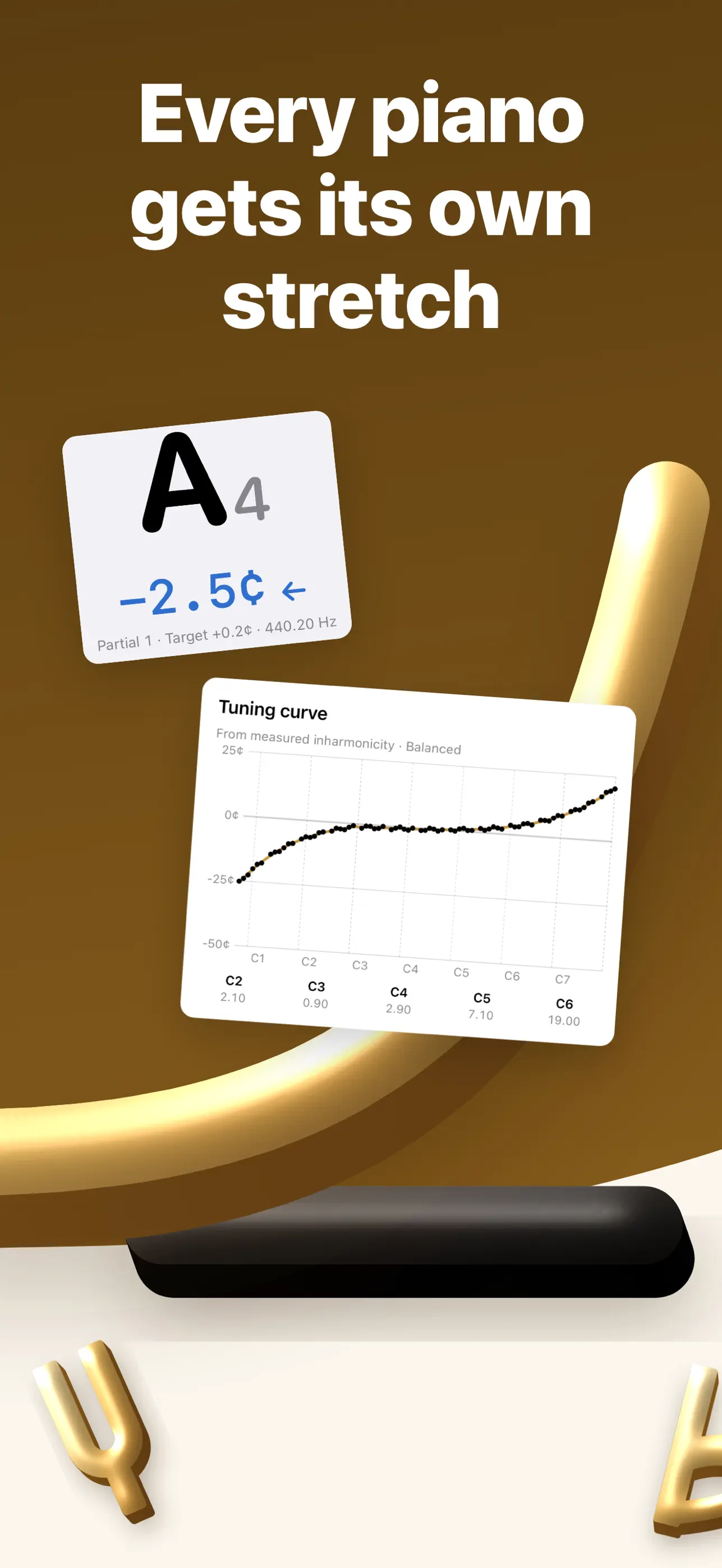
Note that a well-tuned piano is deliberately stretched: its bass sits a few cents flat and its treble a few cents sharp of the equal-temperament numbers a chromatic tuner shows. So small deviations at the extremes are normal; look for changes over time and for notes that disagree with their neighbours.
Keep it in tune longer
- Keep humidity steady. Around 40 to 45 percent relative humidity suits most pianos; a humidifier in winter and a dehumidifier in summer help.
- Keep it away from radiators, vents, windows and direct sun.
- Tune after the season settles, not during the swing.
- Do not let it go years without tuning; a big pitch raise is harder on the piano.
For tuners and serious amateurs
Stretch for iPhone and iPad measures each piano’s own stretch curve from five notes, keeps a file for every piano with its tuning interval and visit history, and shows which notes drifted with Check my piano. The free download includes the strobe tuner from C3 to C6; Stretch Pro is a one-time purchase.
Questions
How often should a piano be tuned?
The Piano Technicians Guild recommends at least twice a year for most pianos after the first year. Pianos that are played a lot, used for teaching or kept where humidity swings may need more.
How often should a new piano be tuned?
More often in its first year, because new strings stretch and the piano settles in your room. The Piano Technicians Guild suggests at least four tunings in the first year.
What happens if a piano is not tuned for years?
It usually goes flat overall, and some notes drift more than others. Bringing it back may need a pitch raise, an extra pass that pulls every string up before the fine tuning.
When is the best time of year to tune a piano?
After a seasonal change has settled, for example a few weeks after the heating goes on or off. Tuning in the middle of a big humidity swing means it drifts again soon.
Can I check if my piano needs tuning myself?
Yes. Play A4 with a tuner app or an online tuner. If it is more than a few cents off 440 Hz, or unisons sound wavy, it is time to book a tuning.
More on piano tuning
Tune every key to your piano’s own curve
Stretch measures five notes and builds the stretch for all 88 keys. For iPhone and iPad.