Equal temperament and beat rates on the piano
Why no keyboard can have every interval pure, and what tuners listen for instead.
Twelve pure fifths overshoot seven octaves by about 23.5 cents, so a keyboard cannot have both. That gap is the Pythagorean comma, and every temperament is a way of spreading it around. Equal temperament spreads it evenly: each fifth gives up about 2 cents, every semitone is exactly 100 cents, and every key sounds the same. It is the standard tuning for pianos today, and it is what the online piano tuner and the piano key frequencies table measure against.
Pure intervals and the cost of equal temperament
A pure interval has a simple frequency ratio. Equal temperament replaces each with a power of the twelfth root of 2:
| Interval | Pure | Equal tempered | Difference |
|---|---|---|---|
| Octave | 2:1, 1200 cents | 1200 cents | 0 |
| Fifth | 3:2, 702.0 cents | 700 cents | 2.0 cents narrow |
| Fourth | 4:3, 498.0 cents | 500 cents | 2.0 cents wide |
| Major third | 5:4, 386.3 cents | 400 cents | 13.7 cents wide |
| Minor third | 6:5, 315.6 cents | 300 cents | 15.6 cents narrow |
Fifths and fourths are close to pure. Thirds are far off, which is why equal-tempered major thirds have the busy shimmer you hear when you hold a chord on a piano.
What a beat is
Each piano note contains a series of partials, roughly at 2, 3, 4 and 5 times its fundamental. Two notes a fifth apart share a partial: the 3rd partial of the lower note and the 2nd of the upper. If the fifth is slightly narrow, those two partials are a little apart and you hear a slow pulsing, a beat. The beat rate is the difference between the two partial frequencies:
- Fifth: 3 × lower − 2 × upper
- Fourth: 3 × upper − 4 × lower
- Major third: 4 × upper − 5 × lower
- Minor third: 6 × lower − 5 × upper
Equal-tempered beat rates at A440
Worked out from the equal-tempered frequencies, before inharmonicity:
| Interval | Notes | Beats per second |
|---|---|---|
| Fifth | A3 to E4 | 0.74 |
| Fourth | A3 to D4 | 0.99 |
| Major third | F3 to A3 | 6.93 |
| Major third | A3 to C♯4 | 8.73 |
| Major third | C4 to E4 | 10.38 |
| Major third | F4 to A4 | 13.86 |
| Minor third | A3 to C4 | 11.87 |
Two patterns matter more than the individual numbers. Beat rates scale with pitch, so the same interval an octave higher beats twice as fast. And consecutive major thirds speed up evenly: each one a semitone higher beats about 6 percent faster. Tuners set the temperament octave in the middle of the piano by checking that progression, and that each fifth beats slowly and evenly.
Why a real piano does not match the table exactly
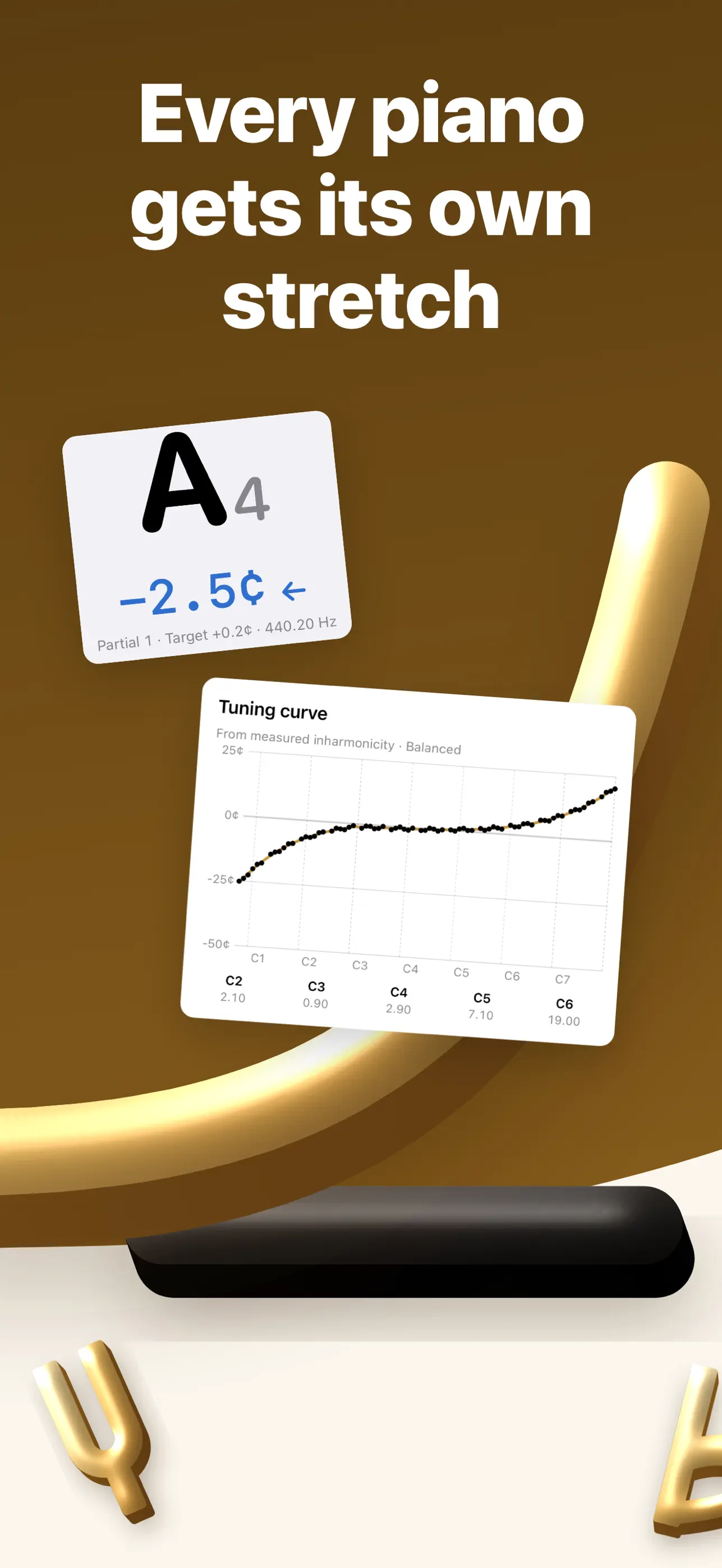
Piano strings are stiff, so their partials run sharp of whole-number multiples, more so on short, thick strings. That inharmonicity shifts where coincident partials meet, which changes beat rates slightly and makes good octaves wider than 2:1. The result is the stretch that gives this site its name: the bass ends up a few cents flat and the treble a few cents sharp of the equal-tempered numbers. Our guide to tuning a piano yourself explains why that means a plain chromatic tuner is not enough.
Other temperaments
Before equal temperament became the norm, keyboard tuners used other ways of distributing the comma.
- Quarter-comma meantone narrows its fifths by about 5.4 cents so that its major thirds are pure. Keys near C sound sweet and calm, but one fifth, usually G♯ to E♭, is left about 36 cents wide: the “wolf”, too harsh to use. Music that stays in a few keys suits it.
- Well temperaments, such as Werckmeister III, Kirnberger III, Vallotti, Young and Kellner, have no wolf. Every key is playable, but thirds near C are purer and remote keys are more tense, so each key has its own colour.
- Equal temperament gives up that colour for complete freedom to modulate and transpose, which is why modern pianos use it.
To hear the difference, tune a harpsichord or a digital piano to a historical temperament and play the same piece in C major and in F♯ major.
For tuners
Stretch for iPhone and iPad uses equal temperament by default, with Werckmeister III, Kirnberger III, Vallotti, Young II, quarter-comma meantone and Kellner for early music, and an editor for your own offsets. Each is applied on top of the piano’s measured stretch curve. For unisons it shows a beat-rate readout in beats per second.
Questions
What is equal temperament?
A tuning in which the octave is split into twelve equal semitones of 100 cents, each a frequency ratio of the twelfth root of 2. Every key sounds the same, at the cost of no interval except the octave being acoustically pure.
Why do piano intervals beat?
When two notes share an overtone that is slightly mistuned, the two partials interfere and the sound pulses. The number of pulses per second is the difference between the two partial frequencies.
How fast should the F3 to A3 major third beat?
About 6.9 beats per second in equal temperament at A440, from the arithmetic of the partials. On a real piano the number shifts slightly with the strings' inharmonicity, so tuners check that thirds speed up evenly as they go up rather than chase one exact figure.
Are fifths pure in equal temperament?
No. Each equal-tempered fifth is about 2 cents narrower than pure, so it beats slowly, under one beat per second around the middle of the piano.
What is the difference between equal temperament and well temperament?
Equal temperament makes every key identical. Well temperaments such as Werckmeister III or Vallotti keep all keys usable but make some purer than others, so keys near C sound calmer and remote keys more colourful.
More on piano tuning
Tune every key to your piano’s own curve
Stretch measures five notes and builds the stretch for all 88 keys. For iPhone and iPad.