What is a piano pitch raise, and does my piano need one?
Why a piano that has gone well flat takes two passes, and how to tell before the tuner arrives.
A pitch raise is an extra, rough tuning pass for a piano that has gone well below pitch. The technician brings every string up close to its target, usually pulling it slightly sharp on purpose, then does the normal fine tuning on top. It exists because a piano cannot be raised a long way in one careful pass: the piano itself changes shape as the tension goes up.
Why one pass is not enough
A piano’s strings together pull on the cast-iron plate and press down on the soundboard through the bridges. Raise every string and that load grows. As you work up the keyboard, the soundboard and plate give a little under the added pull, and the strings you already tuned go flat again.
Tension grows with the square of the frequency, so small pitch changes add up:
| Raise | Extra tension on that string |
|---|---|
| 10 cents | about 1.2 percent |
| 25 cents | about 2.9 percent |
| 50 cents | about 6 percent |
| 100 cents (a semitone) | about 12.2 percent |
Across more than 200 strings, a 50-cent raise is a big change for the instrument.
How the first pass works
The usual approach is overpull: pull each string past its target by a fraction of how far it was flat, so that when the rest of the piano comes up and the string sags back, it lands near pitch.
- Survey: check how far flat the piano is in several places, typically each A across the keyboard.
- First pass: tune quickly through the piano with an overpull that depends on the register and on the survey. The amounts are smaller in the bass, larger towards the treble, and capped so no string is pulled dangerously sharp.
- Second pass: a normal fine tuning to the final stretched targets, including unisons.
The first pass does not need to be precise. Its job is to put the load back on the piano so the second pass holds.
Signs your piano needs one
- It has not been tuned in several years. Pianos usually drift flat when they are left.
- A4 reads well below 440 Hz. Play it into the online piano tuner and read the cents.
- Every A reads flat by a similar large amount. Try A1, A2, A3, A4, A5, A6 and A7. If they are all 20 or 40 cents low, the whole piano has dropped.
- It sounds fine on its own but clashes with other instruments, recordings or a keyboard.
If only a few notes are far off and the rest are close, that is a different problem: slipped strings or loose pins. See why pianos go out of tune.
Risks, and the alternative
Strings that have sat slack for years, especially rusty ones in the treble, can break when brought up. A careful technician raises them gradually and listens for trouble. On some old pianos with weak pins or a tired soundboard, they may suggest tuning the piano where it is, a little below 440, so it is in tune with itself without the extra load. That works for a piano played alone; it will not match other instruments.
A pitch raise is also not something to try yourself. Our guide on tuning a piano yourself covers what is safe for a beginner, and this is not on that list.
Afterwards
Expect the piano to settle and drift more than usual after a big raise. Book the next tuning sooner than the normal schedule, then return to regular visits; how often to tune a piano gives the usual intervals. Keeping it tuned regularly is the way to avoid another pitch raise.
For tuners
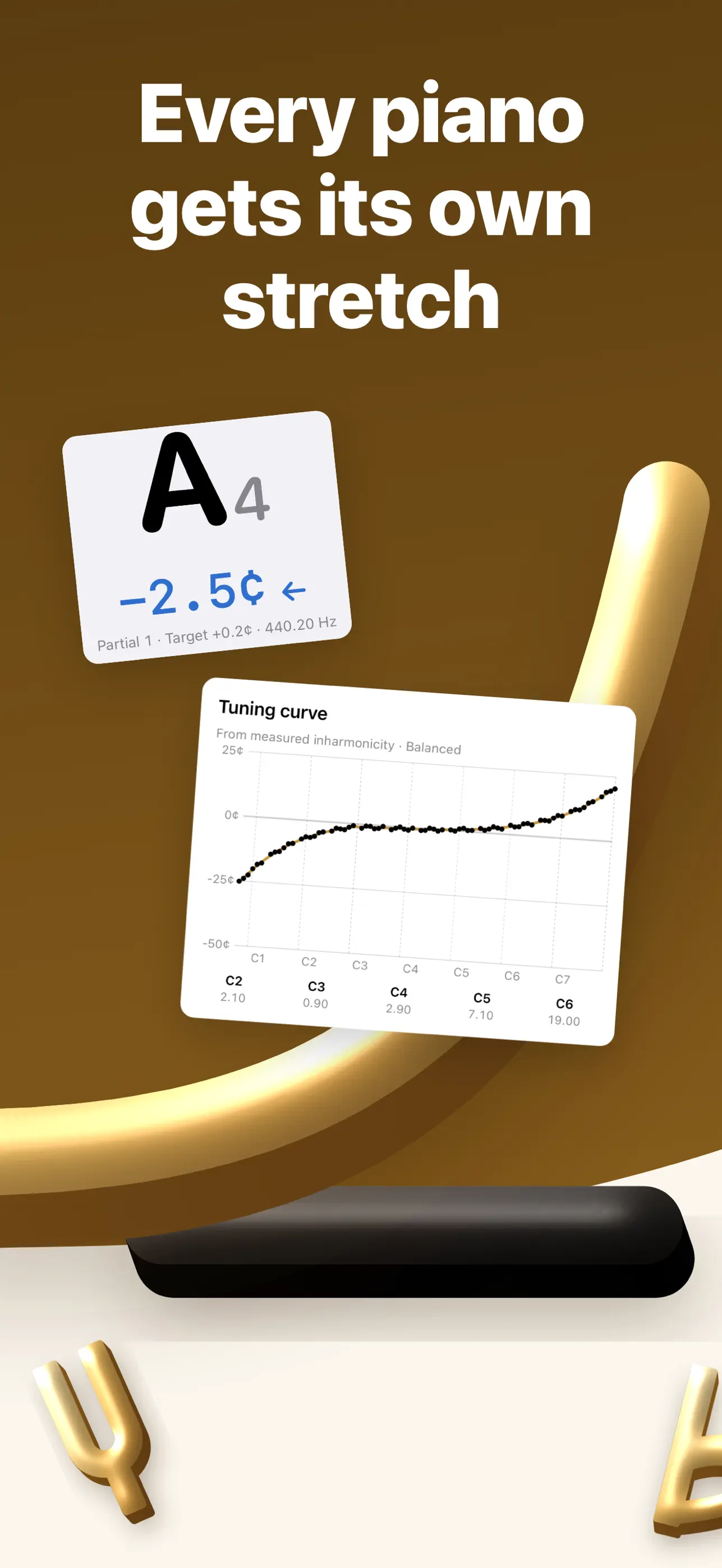
Stretch for iPhone and iPad has a pitch-raise mode. It surveys the A’s from A0 to A7, then runs a first pass that overpulls each section, about 15 percent of the measured deviation in the bass, 25 percent in the middle and up to 40 percent in the high treble, never more than 25 cents, and a second pass to the piano’s measured stretch curve. The overpull for the current key is shown next to the strobe, so you always see where the string should land on this pass.
Questions
What is a pitch raise on a piano?
A quick first pass over the whole piano that brings every string close to pitch, usually pulling each a little past its target. A normal fine tuning follows straight after, or at a later visit.
Why can't a flat piano be tuned in one pass?
Raising the strings adds load to the soundboard and frame. As the later strings come up, the ones tuned earlier sag flat again. The first pass absorbs that change so the second pass can hold.
How flat does a piano have to be to need a pitch raise?
There is no single number; each technician decides from how far off the piano is and how evenly. A few cents of drift comes back in a normal tuning. When most of the piano reads tens of cents flat, plan for a pitch raise.
Can a pitch raise break strings?
It can, mostly on old or rusty strings that have sat slack for years. Raising a string 50 cents adds about 6 percent to its tension. Technicians go carefully on such pianos and sometimes advise tuning below standard pitch instead.
Will the piano stay in tune after a pitch raise?
Less well than after a routine tuning. The piano has just taken on a lot of extra load, so expect it to settle and plan the next tuning sooner than usual.
Tune every key to your piano’s own curve
Stretch measures five notes and builds the stretch for all 88 keys. For iPhone and iPad.