Can you tune a piano yourself?
An honest guide: what a full tuning takes, what can go wrong, and the small fixes that are reasonable to try.
Yes, you can learn to tune a piano yourself, but it is a real skill, and a piano can be damaged by mistakes. A full tuning means setting about 220 strings, one at a time, to stretched targets, with a tuning hammer that moves each pin a tiny amount. Professionals train for months and practise for years. A careful beginner can, however, check the piano’s pitch and fix a single sour unison with low risk. Anything beyond that, especially a pitch raise on a piano far below pitch, is best left to a technician until you have practised.
This page explains what is involved so you can decide.
What a full tuning involves
- Set A4, usually to 440 Hz, with a tuner or fork.
- Tune a temperament octave in the middle of the piano, so every interval is correct.
- Tune outward by octaves, matching each new note to the one already tuned, with the octaves stretched to suit this piano’s strings.
- Tune the unisons: most notes have two or three strings that must match exactly.
- Set the pins so they hold, which is the part that takes the longest to learn.
The tools
- A tuning hammer (also called a lever) with a tip that fits the pins.
- Mutes: rubber wedges or a felt strip to silence the strings you are not tuning.
- A reference: a tuner that understands piano stretch, or a trained ear.
Why a chromatic tuner is not enough
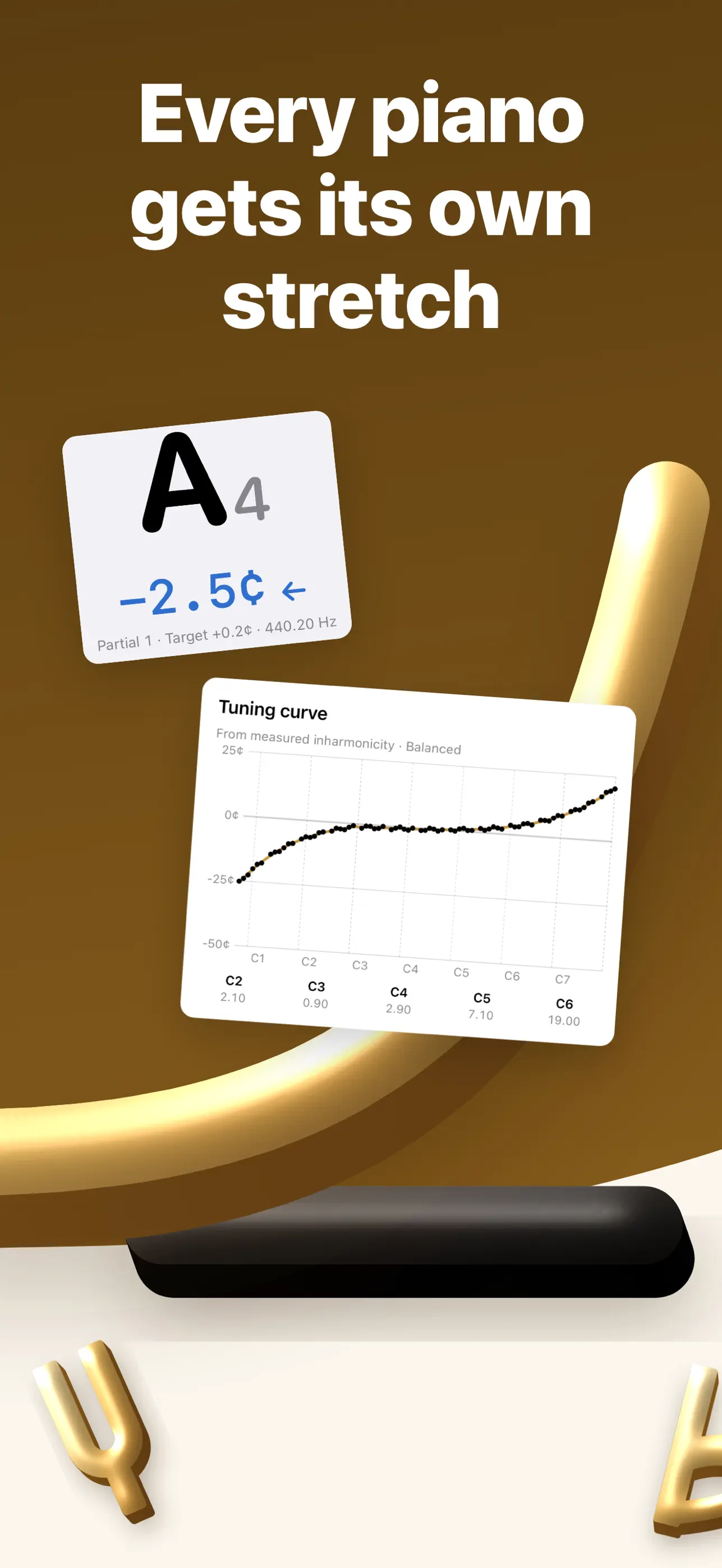
Piano strings are stiff, so their overtones run sharp. Well-tuned octaves follow the overtones and come out slightly wider than 2:1, so the bass ends up a few cents flat and the treble a few cents sharp of the equal-temperament numbers a chromatic tuner shows. Tune a piano exactly to a chromatic tuner and the octaves beat and the treble sounds flat. You need stretched targets for each key, measured for this piano.
The risks
- Breaking strings, by turning the wrong pin or pulling a string far sharp.
- Loosening pins, by flexing them back and forth; the piano then will not hold a tuning.
- Uneven tension across the piano after a big change, which can make the tuning unstable.
- Injury: a breaking string can whip. Wear eye protection and keep your face away.
Safe things a beginner can try
Check the pitch
Use the free online piano tuner: pick a key, play it and read the cents. It tells you whether the whole piano is flat or just a few notes are off, which helps whether you tune or call someone. See why pianos go out of tune for what the pattern means.
Fix one sour unison
When one note sounds wavy, one of its strings has drifted away from the others:
- Mute all but two strings of the note.
- Play the note and listen for slow beats, a wah-wah in the sound.
- With the hammer on the pin of the string that drifted, make a very small turn until the beats slow and stop. Turn only slightly; a few degrees is a lot.
- Check that the note is in tune with its neighbours, then unmute.
Always confirm which pin belongs to the string you are playing by plucking or watching the string as you touch the pin.
When to call a technician
- The piano is far below pitch and needs a pitch raise.
- Pins feel loose or the piano will not hold a tuning.
- Strings are rusty or a string has broken.
- You want the piano to sound its best for a performance.
How an app helps
Stretch for iPhone and iPad measures your piano’s inharmonicity from five notes, C2 to C6, and builds a stretched target for all 88 keys, then guides you key by key with a three-band strobe. Its guided touch-up fixes a sour unison and refuses an unsafe raise, and Check my piano shows which notes drifted. The free download includes the strobe tuner from C3 to C6; Stretch Pro is a one-time purchase. For how often a piano needs this, see how often to tune a piano.
Questions
Can I tune my own piano?
You can learn to, but a full tuning is a skill that takes many practice tunings to do well. A careful beginner can reasonably check pitch and fix a single sour unison; a full tuning or a pitch raise is best left to a technician at first.
What tools do I need to tune a piano?
A tuning hammer (lever) that fits the pins, rubber or felt mutes to silence strings, and a tuner that understands piano stretch, or a well-trained ear.
Can I tune a piano with a tuner app?
A chromatic tuner shows equal temperament, but pianos need stretched octaves. A piano tuning app that measures inharmonicity can give correct targets; the hammer technique is still the hard part.
Can I break a string tuning a piano?
Yes. Turning the wrong pin, pulling a string far sharp or raising an old piano too fast can break strings. Always mute and check which pin belongs to the string you are playing.
How long does it take to tune a piano?
A professional tuning usually takes one to two hours. A beginner's first full tuning takes much longer.
More on piano tuning
Tune every key to your piano’s own curve
Stretch measures five notes and builds the stretch for all 88 keys. For iPhone and iPad.